

Service
Renovations and new construction
Rough-in through finish for additions, gut renovations and new houses, coordinated with the trades around you.
Renovation electrical is mostly a scheduling problem. The wiring is not the hard part. Being in the right place at the right time, before the insulation and after the framing, is.
Where the renovation electrical work happens
At the drawing stage, ideally. Outlet placement, where the panel ends up, whether the service can carry the finished house and where the runs will physically go are all cheap decisions on paper and expensive ones in framed walls.
At rough-in, running everything before insulation and drywall, with the inspection booked around the other trades rather than after them.
At finish, devices, fixtures, panel labelling and the final inspection.
The capacity conversation
Nearly every renovation adds load. A new kitchen, a heat pump, an EV charger in the plan for later, a basement suite. The time to work out whether the service carries all of that is at the start, when a panel upgrade is one more line on a schedule rather than a surprise in month three.
New construction
For new builds we work from the drawings, price the whole electrical scope including the service, and stage the work to the build schedule. Tell us early about anything unusual: a shop, a detached garage, solar, a generator, or a suite that has to be separately metered.
Permits and inspections
Renovation electrical is permitted and inspected work, and we handle both as part of the job rather than leaving them with you or the contractor. Rough-in gets inspected before insulation closes the walls, finish gets inspected at the end, and the paperwork lands where your occupancy or insurance needs it.
What we ask of you
Decide the kitchen layout before rough-in. It is the single thing that changes most often after the walls are closed, and it is the most expensive one to change.
Nearly every renovation ends up touching the panel, and most of them involve lighting decisions that are cheap before the ceiling closes and expensive after.
The inspection sets everybody’s schedule
This is the part that catches renovations, and it is worth understanding before the drywall is booked.
On any job that opens walls there are two inspections. The rough-in inspection happens after the cable is run and before it is concealed. The final happens once devices are in. If the insulation and board go up before the rough-in is inspected, some of it comes back off, and that is not a disagreement anyone wins with the inspector.
So the electrical rough-in is not a task on the critical path, it is a gate. Tell us the drywall date at the start and we will work back from it. The process itself is on the electrical permits and inspections page.
Working with the other trades
Plumbing and HVAC generally get first claim on the joist bays for good reasons, and electrical can route around them. That works when everyone knows the order. It does not work when three trades are booked for the same week without a conversation.
We are used to being the trade that coordinates this on smaller residential jobs, and we would rather do that than arrive to find the ducting where the panel feeder was going.
Labelling, and why we do it during rough-in
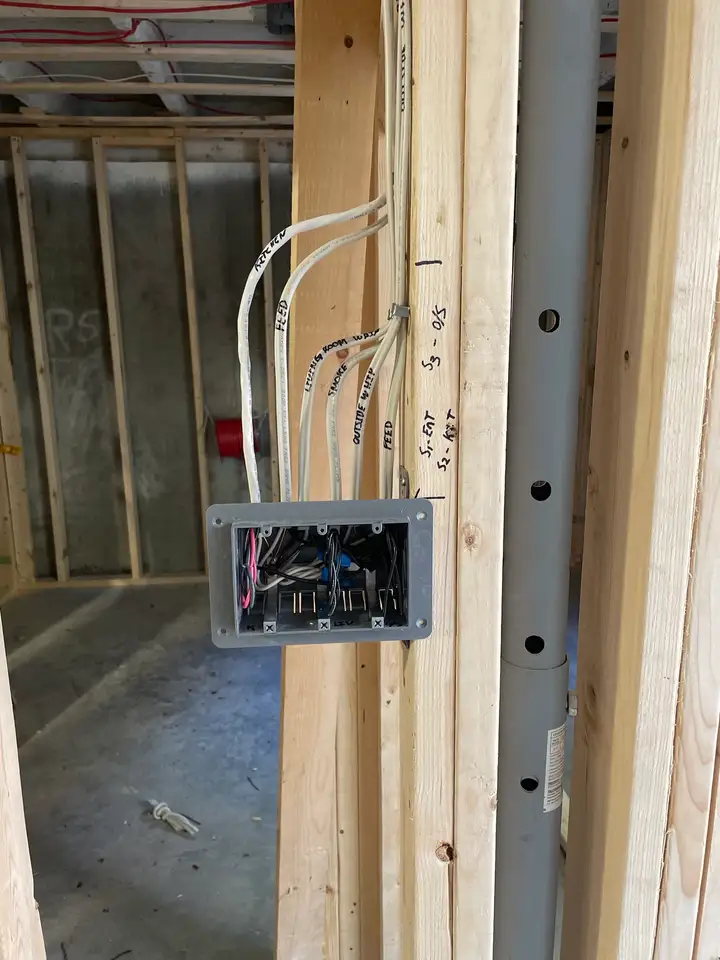
Every cable gets marked at the box for what it is and where it goes, before anything is covered. It costs a few minutes at rough-in and it saves hours at finish, at the final inspection, and again in five years when somebody adds a circuit. You can see what that looks like in the recent work gallery.
Decide these before rough-in
Where the panel goes, and whether there is room in front of it to work. Whether the basement is being finished later, because the time to run the conduit is now. Whether there will be an EV, a heat pump or a hot tub within five years. Every one of those is cheap while the walls are open and expensive afterwards.
If the answer to two or more of them is yes, the service size needs deciding before rough-in rather than after, which usually means a panel upgrade in the same programme.
What will this cost?
Nobody can price this down the phone, and anyone who does is guessing. What you can find out now is what will decide the number on your house.
Answer three questions about renovations and new construction
Common questions
When should the electrician get involved?
Earlier than most people think. Once the walls are closed, changing where a circuit goes stops being cheap. A conversation at the drawing stage is worth several at the framing stage.
Do you work with our general contractor?
Yes, and with the HVAC and plumbing trades directly. Most of the avoidable problems on a renovation come from three trades wanting the same joist bay.
Can you do just the rough-in?
We would rather do rough-in and finish on the same job. Whoever does the finish inherits the rough-in's decisions, and splitting it tends to cost the homeowner more than it saves.