

Service
EV charger installation
Level 2 home charging, wired properly, with the load calculation done before anything is ordered.
In any EV charger installation the charger itself is the easy part. The question worth answering before you buy one is whether your house can feed it.
A Level 2 charger needs a dedicated 240 volt circuit, sized to the unit and protected accordingly. Whether your service can carry that depends on what else is already on it, which is why the first thing we do is a load calculation rather than a quote.
What decides the cost of EV charger installation
Three things, in roughly this order.
The run. A charger on the garage wall directly behind the panel is a short run. A charger at the far end of a detached garage means a buried feeder and a sub-panel, which is a different job entirely, and the trench is usually the largest line on the estimate.
Whether the service has room. If the calculation says the existing service cannot carry the load, the answers are a service upgrade or a load management device that shares capacity. Both are real. Guessing is not.
The unit. Hardwired against plug-in, indoor against outdoor rated, and whether it needs a network connection all change the work.
What the install actually involves
Every EV charger installation is three things: a load calculation, a dedicated circuit, and an inspection.
The load calculation comes first, and it decides whether your service can carry the charger at all. It is not a formality. An EV charger is one of the largest continuous loads a house will ever take on, and it runs for hours at a time rather than in bursts.
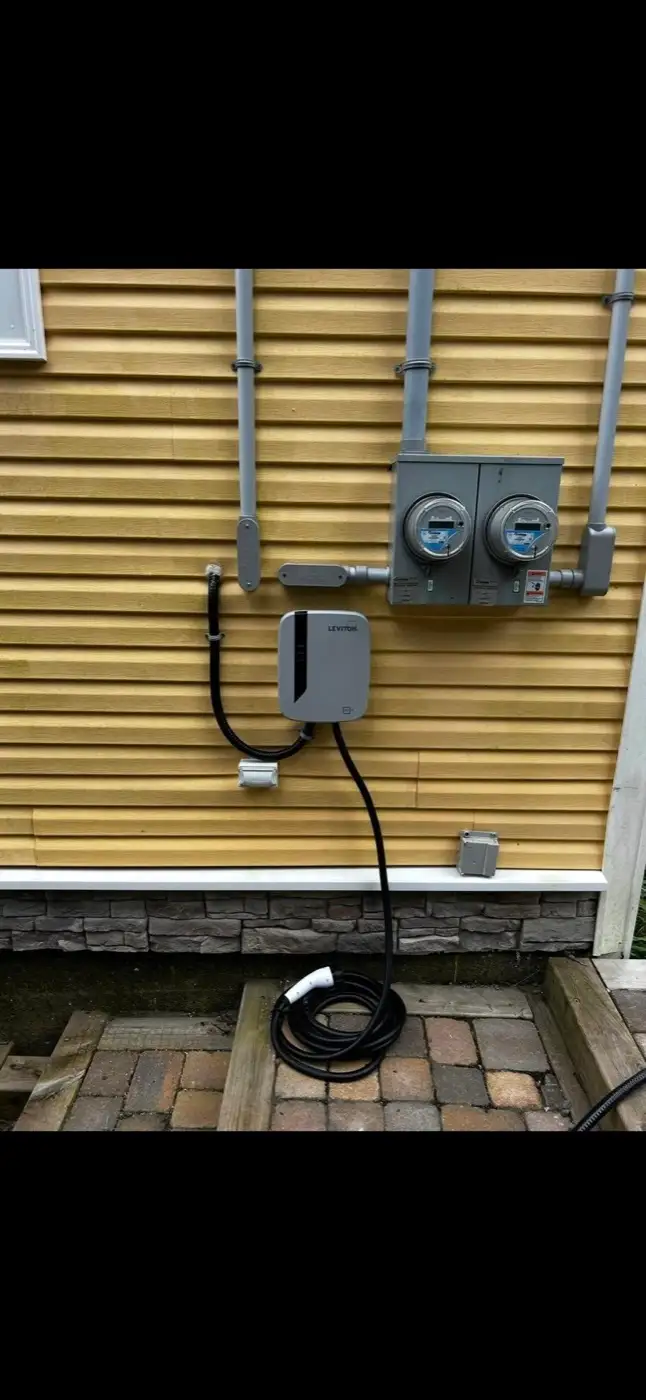
Then the circuit itself, run from the panel to wherever the car actually parks, terminated at the unit and mounted at a height that suits the cable rather than the wall.
What we will not do
We will not put a charger on an undersized service and hope. The failure mode is not a nuisance trip; it is an overloaded service, and it is exactly the kind of thing that shows up in an insurance investigation after something else has gone wrong.
When the service will not carry it
There are two honest answers here rather than one.
A panel upgrade gives you the capacity properly and solves the next three things you add as well. Load management shares existing capacity between the charger and another large load, so the charger backs off when the dryer runs. It is cheaper and it is a real engineering answer rather than a fudge, but it is a compromise and you should be told that it is one.
Two cars, or a car later
If a second EV is plausible within a few years, say so at the quote stage. Running the right conduit once is far cheaper than running it twice, and the decision costs almost nothing while the wall is open.
If a heat pump is also in the plan, work both out at the same time rather than one after the other. Two load calculations done separately can each say yes and still be wrong together.
Hardwired or plug-in
Both are legitimate and the choice has consequences.
Hardwired is tidier, has no receptacle to fail, and on most units allows the full output. It is also permanent.
Plug-in on a proper 240 volt receptacle lets you take the unit with you or swap it, and it means the receptacle rather than the charger is the fixed part. It caps the current lower on most units and the receptacle itself has to be the right grade, because the cheap ones are not built for a car charging every night for ten years.
The Efficiency Nova Scotia rebate
Efficiency Nova Scotia pays a rebate toward a Level 2 home charger, currently $500. Two things are worth knowing about it before you buy anything.
The rebate is for the charger, not for the electrical work behind it. If your service cannot carry the circuit, the load calculation and any panel upgrade are yours regardless, and they are usually the larger number. Budget for the install rather than the rebate.
Rebate programs also change, and they change without much warning. Check the current terms on the Efficiency Nova Scotia site before you order, and if the timing matters to you, tell us at the quote stage so the install can be sequenced around it.
The permit
An EV charger on a new circuit is permitted work, and in this province only a certified electrician can pull that permit. How that runs is on the electrical permits and inspections page.
What will this cost?
Nobody can price this down the phone, and anyone who does is guessing. What you can find out now is what will decide the number on your house.
Common questions
Do I need a panel upgrade to install a Level 2 charger?
Sometimes, and the load calculation is what tells us. A 200 amp service in a house with a gas range and no heat pump usually has room. A 100 amp service already running a heat pump and an electric water heater often does not. We work it out before you buy anything.
How fast is Level 2 compared to a normal outlet?
A standard 120 volt outlet adds a few kilometres of range per hour, which suits a plug-in hybrid and frustrates everyone else. A Level 2 circuit at 240 volts typically fills a battery overnight, which is why almost every home installation is Level 2.
Can you install a charger I bought myself?
Yes. Tell us the model before we quote, because the circuit size and the mounting depend on it.