

Service
Lighting installation
Pot lights, under-cabinet, outdoor and landscape lighting, installed and controlled properly.
Lighting installation is the only electrical work in a house that gets looked at every day, which is why the layout decides whether it was worth doing and the fixture count rarely does.
Interior lighting installation
Pot lights and recessed lighting. Layout first, count second. Where the light lands matters more than how many fixtures are in the ceiling, and a plan drawn against the room’s actual use beats a grid.
Under-cabinet. The single highest-value lighting upgrade in most kitchens, because it puts light on the work surface rather than on your back.
Switching and control. Dimmers that match the fixtures, three-way switching that makes sense from the door you actually walk in through, and separate control for separate purposes.
Exterior
Security and motion. Placed to light the approach rather than to blind the person walking up it, and aimed so that traffic on the road and animals crossing the driveway do not set it off all night.
Landscape. Low voltage, on its own transformer, laid out so the fixtures themselves are not what you see.
Entrances and steps. The most useful exterior lighting in this climate is whatever stops somebody falling on an icy step in December.
Fixtures you supply
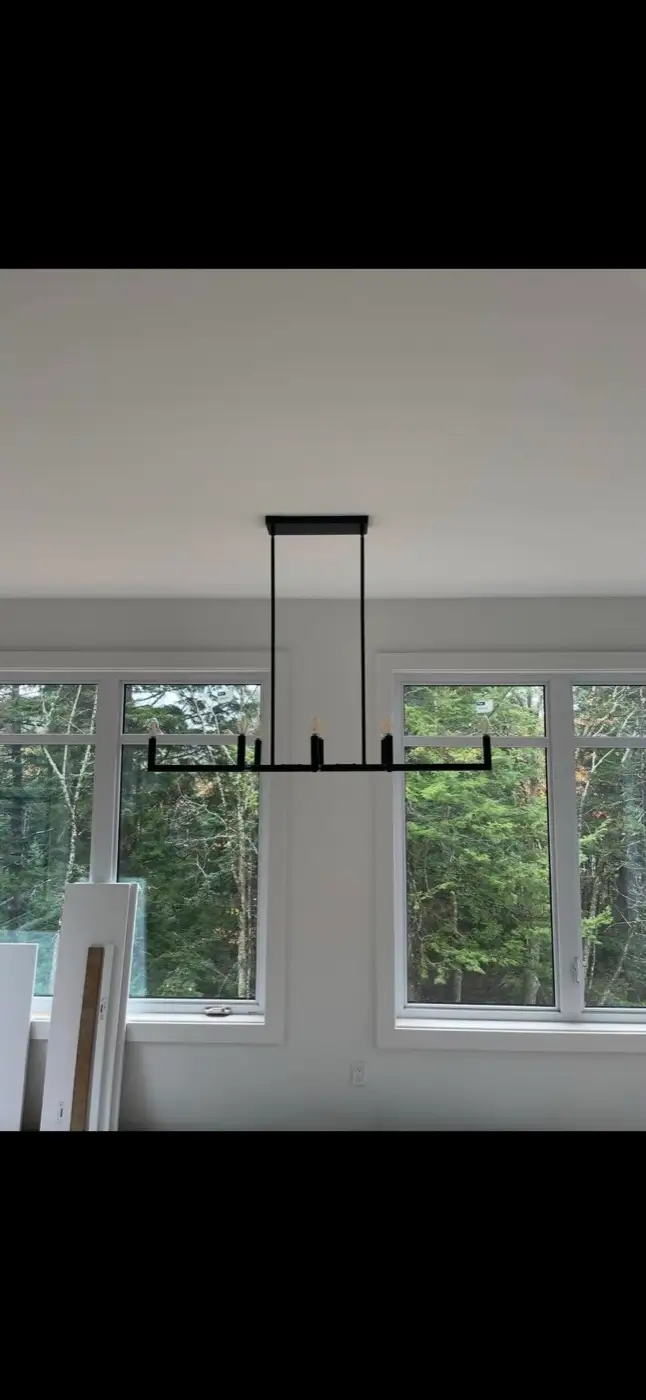
Most lighting installation jobs start with fixtures you have already chosen, and that works fine: tell us what you bought and where it goes, and we will flag anything that needs more than the box it replaces, a heavy chandelier that wants proper blocking, a fan where only a light was wired, a fixture whose transformer needs somewhere to live.
A note on smart lighting
Smart bulbs and switches are worth having when they solve something specific. They are worth avoiding when they add an app to a task that a wall switch already did in one motion. If you want lighting you can control from a phone, we would rather put the intelligence in the switch than in every bulb, because bulbs get replaced and switches do not.
Most of this work happens during a renovation, and a large lighting plan occasionally needs more circuits than the panel has.
Pot lights in an older ceiling
The most requested lighting job in this region, and the one with the most hidden variables.
What is above the ceiling. Insulation contact matters. A fixture that is not IC rated cannot be buried in insulation, and in an insulated attic that rules out a lot of cheap fixtures. In a peninsula house with plaster and lath, the ceiling itself decides how many holes are reasonable.
Where the joists run. They decide the spacing, not the drawing. A layout that ignores the framing ends up either off-grid or with holes cut and patched.
Vapour barrier. Puncturing it in a cold-climate ceiling without sealing properly is how you get condensation in the attic. This is a building problem caused by an electrical decision, and it is worth getting right.
Switching and dimming
Dimmers and LED are still not automatically compatible. The wrong pairing gives you flicker at the bottom of the range, buzz, or a lamp that will not turn fully off. Matching the dimmer to the specific driver is the fix, and it is cheaper to do at the start than to buy twice.
Three way and four way switching in an older house often has no neutral at the switch box, which rules out most smart switches until a neutral is run. Worth knowing before you buy the switches.
Outdoor and landscape
Different rules and a different failure mode. Fixtures and boxes have to be rated for wet locations, receptacles outdoors need GFCI protection, and in a salt air environment the fitting that was fine inland corrodes in three years. On exposed sites near the water it is worth spending more on the fitting than on the light.
Supplied fixtures
Happy to install what you have bought. Two honest caveats: we cannot warrant a fixture we did not supply, and a fixture that arrives missing its mounting hardware turns a one hour job into two visits. Unbox it before the day.
More finished lighting work is in the recent work gallery.
What will this cost?
Nobody can price this down the phone, and anyone who does is guessing. What you can find out now is what will decide the number on your house.
Common questions
How many pot lights does a room need?
Fewer than most people are quoted. Spacing, beam angle and colour temperature matter more than count, and a ceiling covered in evenly spaced downlights tends to look like an office. We would rather plan the layout with you than sell you a number.
Can you add lighting without tearing up the ceiling?
In most cases yes. Access from above, careful fishing and remodel-rated housings avoid a great deal of damage. Plaster ceilings are more work than drywall, and we will say so before starting rather than after.
What colour temperature should I choose?
Warmer light suits living spaces, neutral suits kitchens and workspaces. The mistake to avoid is mixing temperatures in one sightline, which is very visible once you have noticed it.